
Challenge
The role of design was changing fast. AI tools were reshaping how products get built, but the new process lived in my head and a handful of scattered documents. New designers had no single source for how we actually work now: which tools to set up, when to prototype in code versus Figma, and how to hand off to engineering. If the new way of working was going to scale beyond me, it had to become something a designer could learn on their own.
Solution
I built the hub as a Next.js site organized around the questions a designer actually has, from their first day to their hundredth prototype.
Getting set up
An onboarding path that walks a new designer through the tooling stack — Cursor, Claude, and Claude Code — step by step, and hands off to the AI Prototyping Guide and the Savvy Sandbox. The goal is a designer going from a fresh laptop to shipping a prototype without needing me in the room.
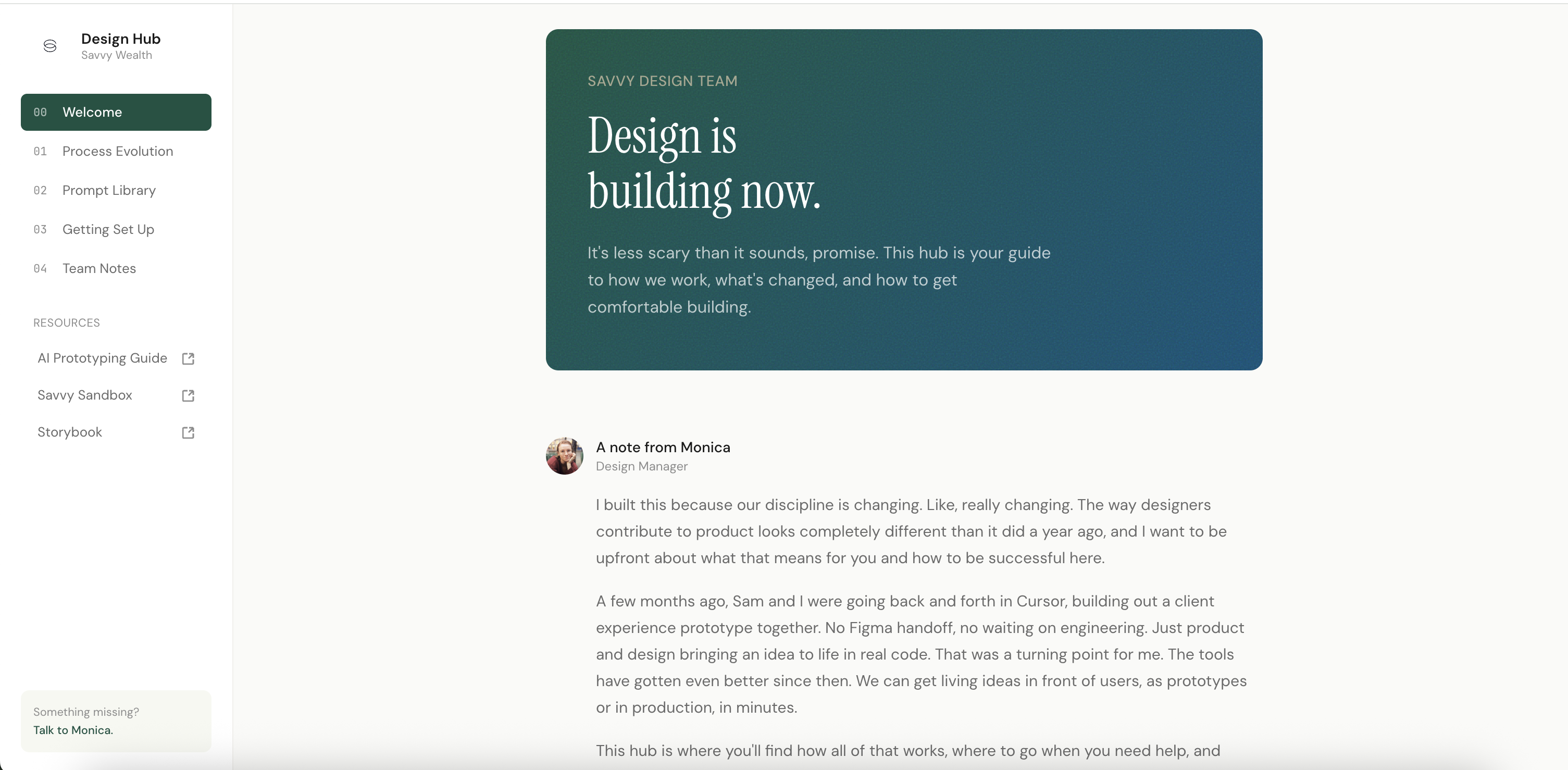
The Design Hub — a central home for how the team works
The process, old vs. new
The heart of the hub is a side-by-side of how design used to flow (idea → Figma exploration → handoff → engineering builds) versus how it flows now (idea → explore directly with Claude → iterate in real code → ship or hand off). It includes the decision points that actually come up: is this a small UI tweak, a new feature, or something that needs backend work? A 'discernment check' helps designers choose the right path instead of defaulting to Figma every time.
A prompt library
A library of reusable prompts for common design and prototyping tasks, so the team isn't reinventing the same prompt every time. It captures what's working and turns individual discoveries into shared practice.
The team
A simple team page so the hub doubles as a who's-who — useful for onboarding and for connecting work in the sandbox back to the people building it.
Impact
The hub turned tribal knowledge into a teachable system. New designers can onboard into the AI workflow from one place, and the process is explicit rather than something I have to explain over and over. It also ties the pieces together: the AI Prototyping Guide, the Savvy Sandbox, and the design process now live as one connected story instead of disconnected links.
Reflections
My job as a leader is to make the right thing the easy thing. The hub is that principle as a product — lightweight structure so designers don't have to reinvent the wheel every time.
The hardest part was documenting a process that's still evolving. I made peace with the hub being a living thing rather than a finished artifact. It changes as the tools and the team change, and that's the point.