Challenge
Etsy's product teams were building features based on stakeholder requests and annual roadmaps — without validating assumptions or testing with users first. This led to expensive development cycles, low adoption, and mounting team frustration. The ask was agile coaching, but the real problem ran deeper: there was no shared understanding of how good product work should actually happen.
Solution
The rollout took a full year. We didn't hand over a playbook and leave — we built it with them, tested it on pilot teams, and scaled what worked.
Lean Value Tree
We worked with Etsy's VPs of Engineering, Product, and Design to co-create a Lean Value Tree — a shared framework that connected company bets to team-level outcomes. This gave everyone a common structure for making decisions about what to build and why, without needing a top-down roadmap to tell them.
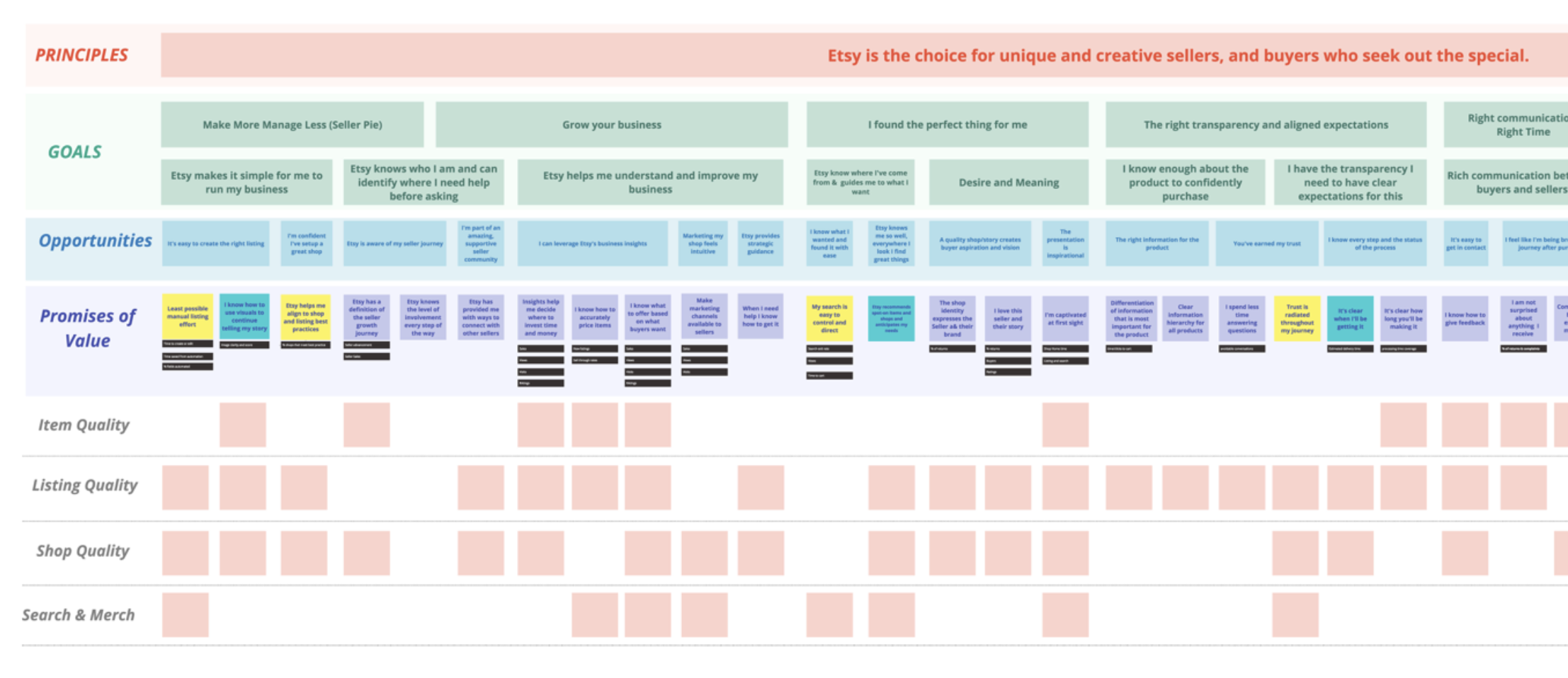
Lean Value Tree: Strategic framework
Hypothesis backlog
With a shared north star in place, we built a backlog of lightweight process experiments: better user story writing, clearer acceptance criteria, kickoff rituals, journey mapping sessions, desk checks, and low-fidelity user testing. Teams ran these experiments alongside their normal work and we evaluated them on two dimensions — how much they improved collaboration, and how many validated hypotheses actually made it to engineering.
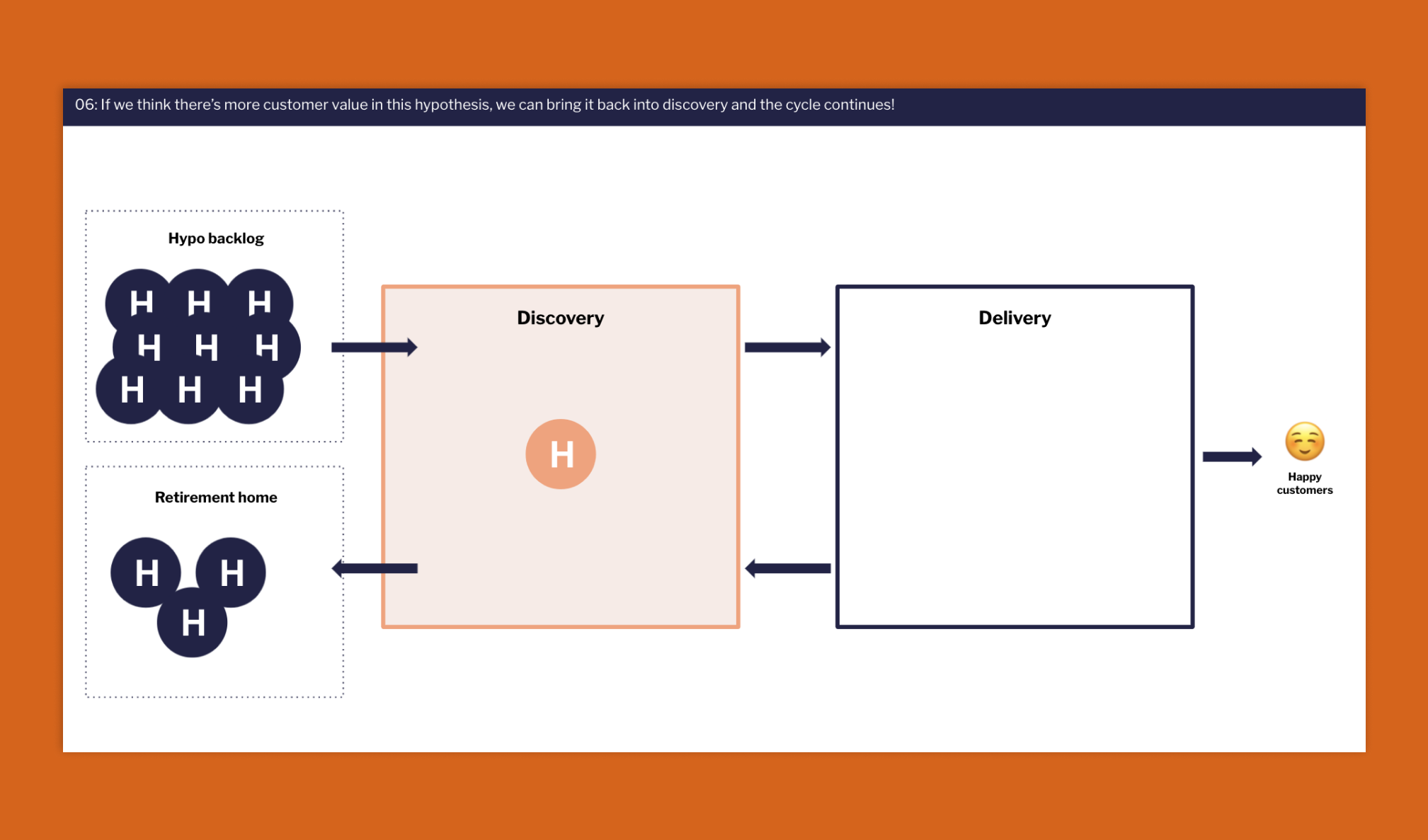
Hypothesis backlog: Experiments and validation
Stoplight framework
I introduced a stoplight review framework to help designers and PMs make explicit decisions about their experiments: move forward, keep exploring, or sunset. Having a structured moment to evaluate progress — rather than letting things quietly stall — turned out to be one of the most valuable changes. By the end of the pilot phase, our team had enabled 30+ new product practices across Etsy's pilot teams.
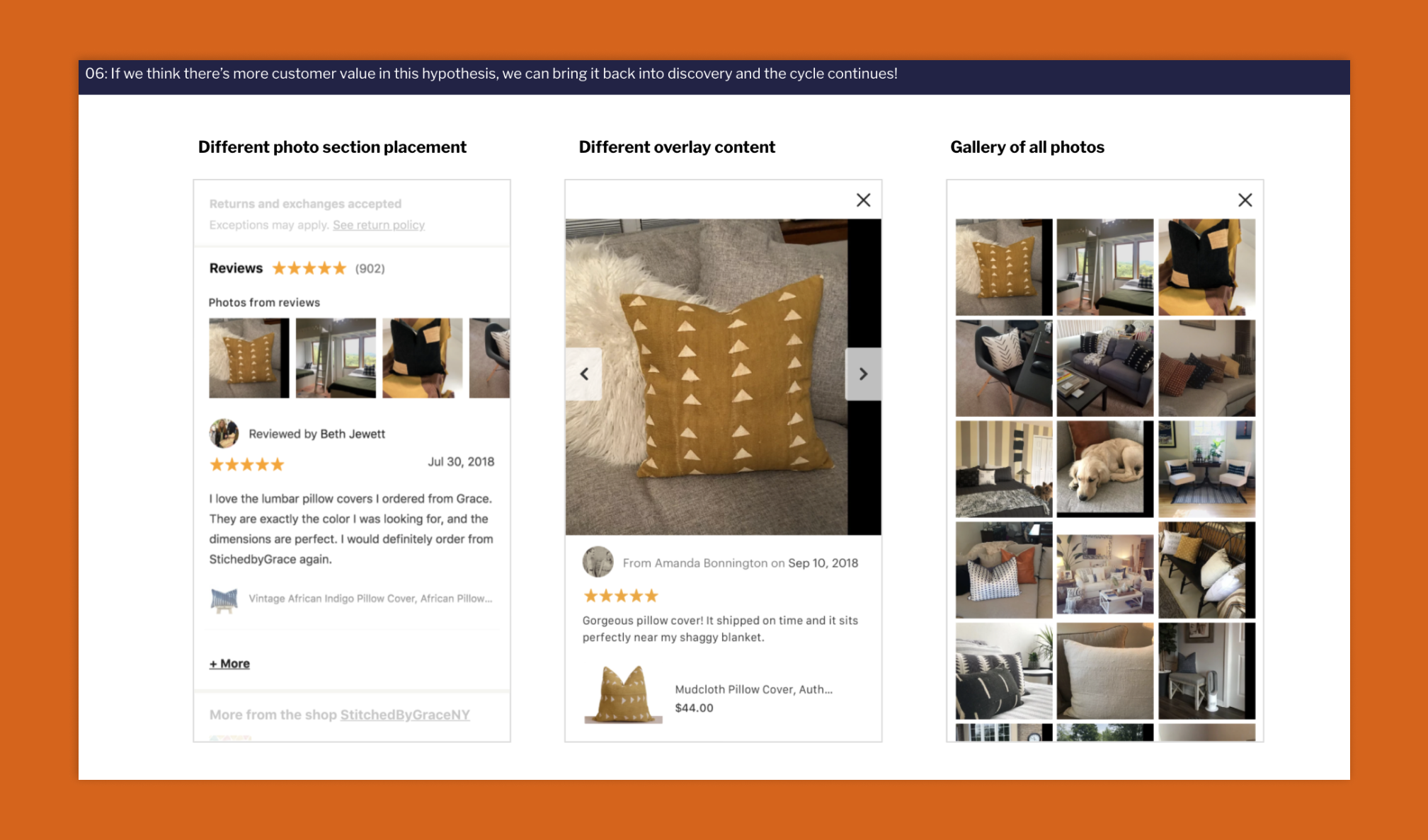
Stoplight framework: Experiment review process
The hardest shift: outcome-based roadmaps
Replacing prescriptive roadmaps with outcome-driven thinking was where we hit the most resistance. Product managers were comfortable with feature lists. Leaders were used to approving them. The ambiguity of an outcome-based model felt risky to people who'd never worked that way. We learned quickly that the fastest way to break through wasn't more explanation — it was getting leaders physically present in a user research session or hypothesis review. Every time that happened, the conversation shifted. Adoption followed.
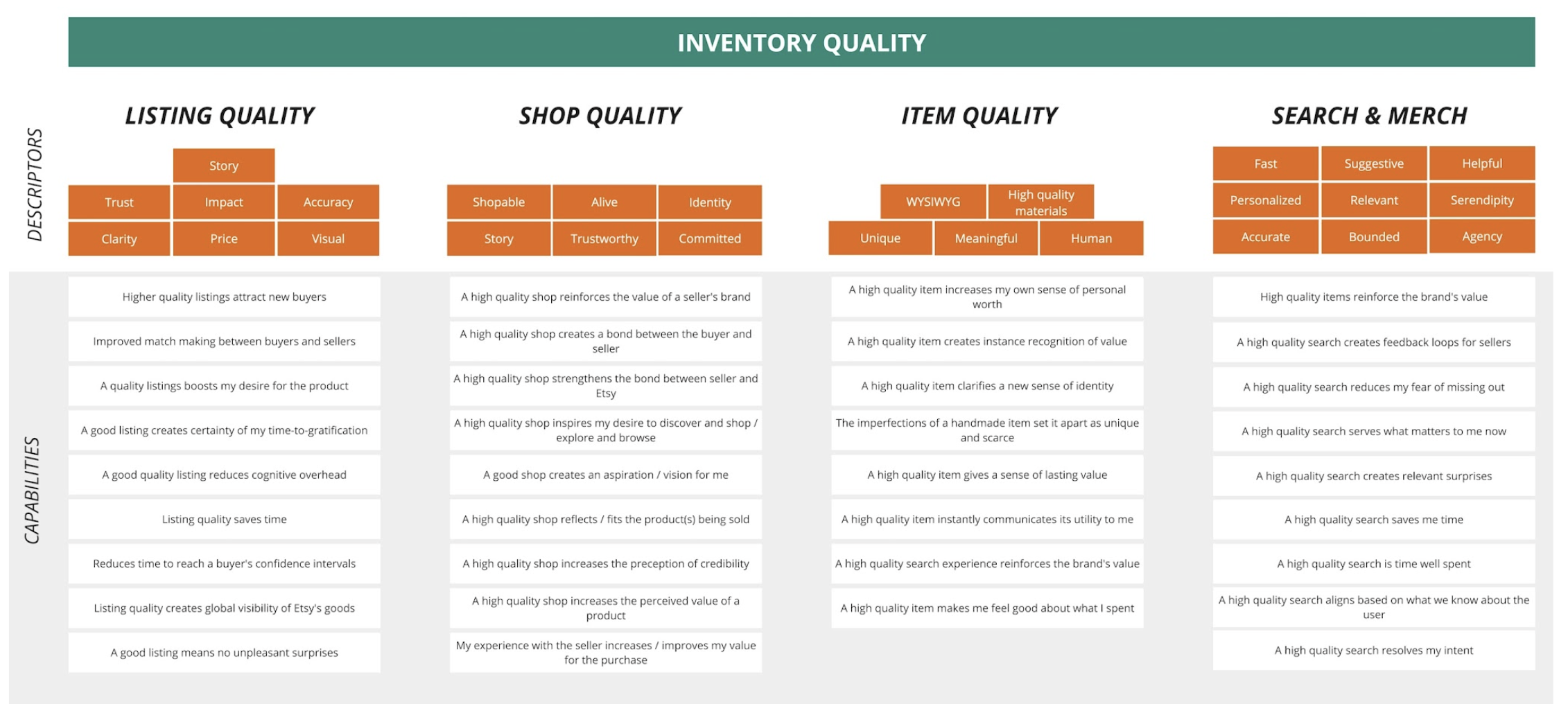
Outcome-based roadmaps: Shift from features to outcomes
Impact
The initiative led to the creation of the "Etsy Way" — a set of shared principles and playbooks that codified how product work should happen across the organization. 30+ new product practices were embedded into pilot teams and scaled globally over the following year. Research transformed most visibly: teams went from running usability tests late in the process to validating high-level concepts with users weekly. It stopped being a siloed function and became part of how every team operated. Years later, I caught up with a former client over a beer and asked if any of it had stuck. He smiled and said, "It's like you all never left." That's the best outcome I know how to measure.
Discovery
Before recommending anything, we spent six weeks inside the organization. What we found wasn't a process problem — it was a clarity and alignment problem.
Interviews across every level
We conducted interviews from individual contributors up to the C-suite. I facilitated a service blueprinting session that mapped the employee journey from the IC perspective, then layered in the supporting actions of leadership and operations. The goal was to surface the systemic friction points that weren't visible from any single vantage point.
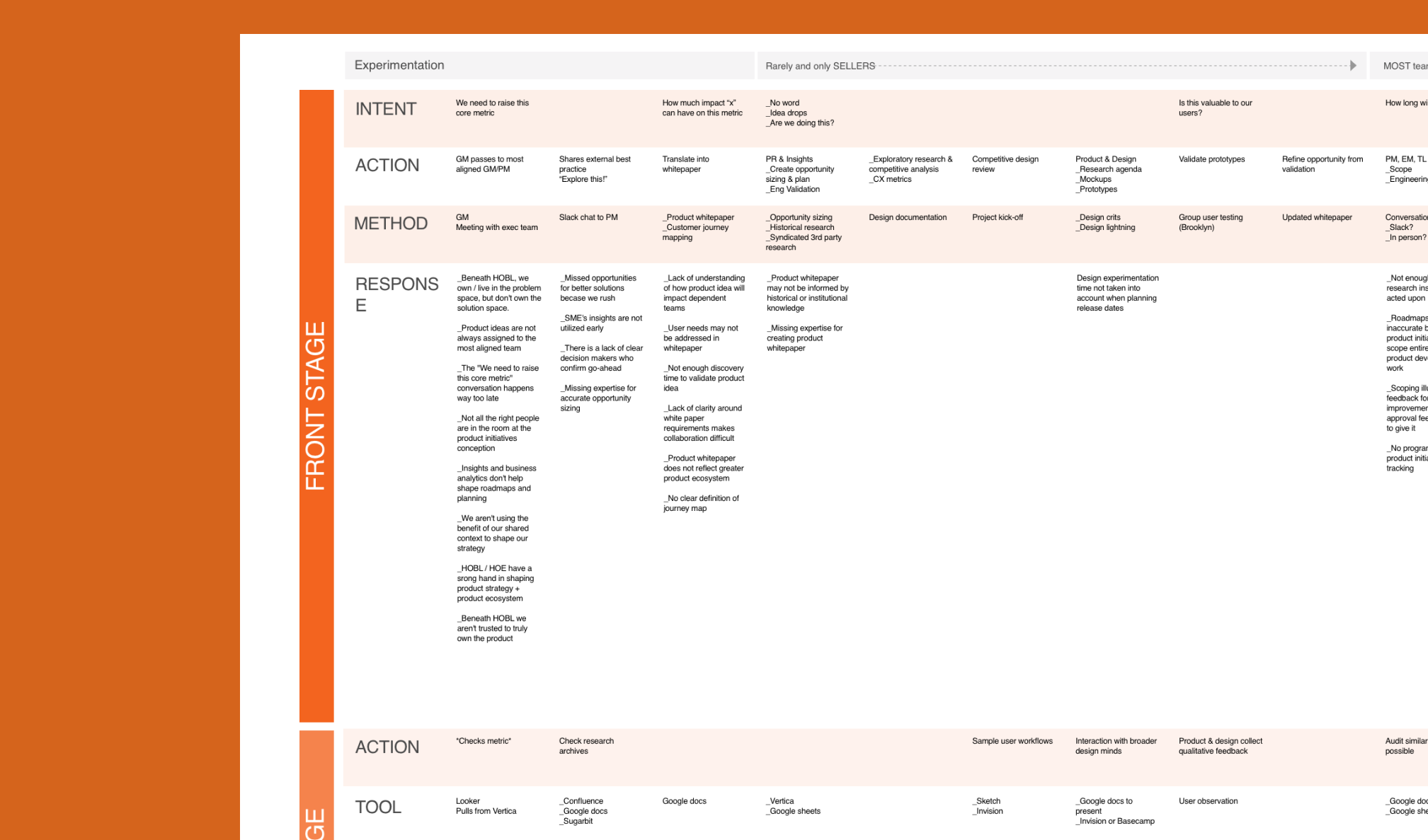
Service blueprint: Employee journey mapping
What we found
Two patterns emerged consistently across teams. First, product discovery was minimal — teams were jumping straight to solutions handed down from above. Second, delivery practices varied so widely across teams that there was no shared language for how work should move. You couldn't install a consistent culture on top of that kind of fragmentation.
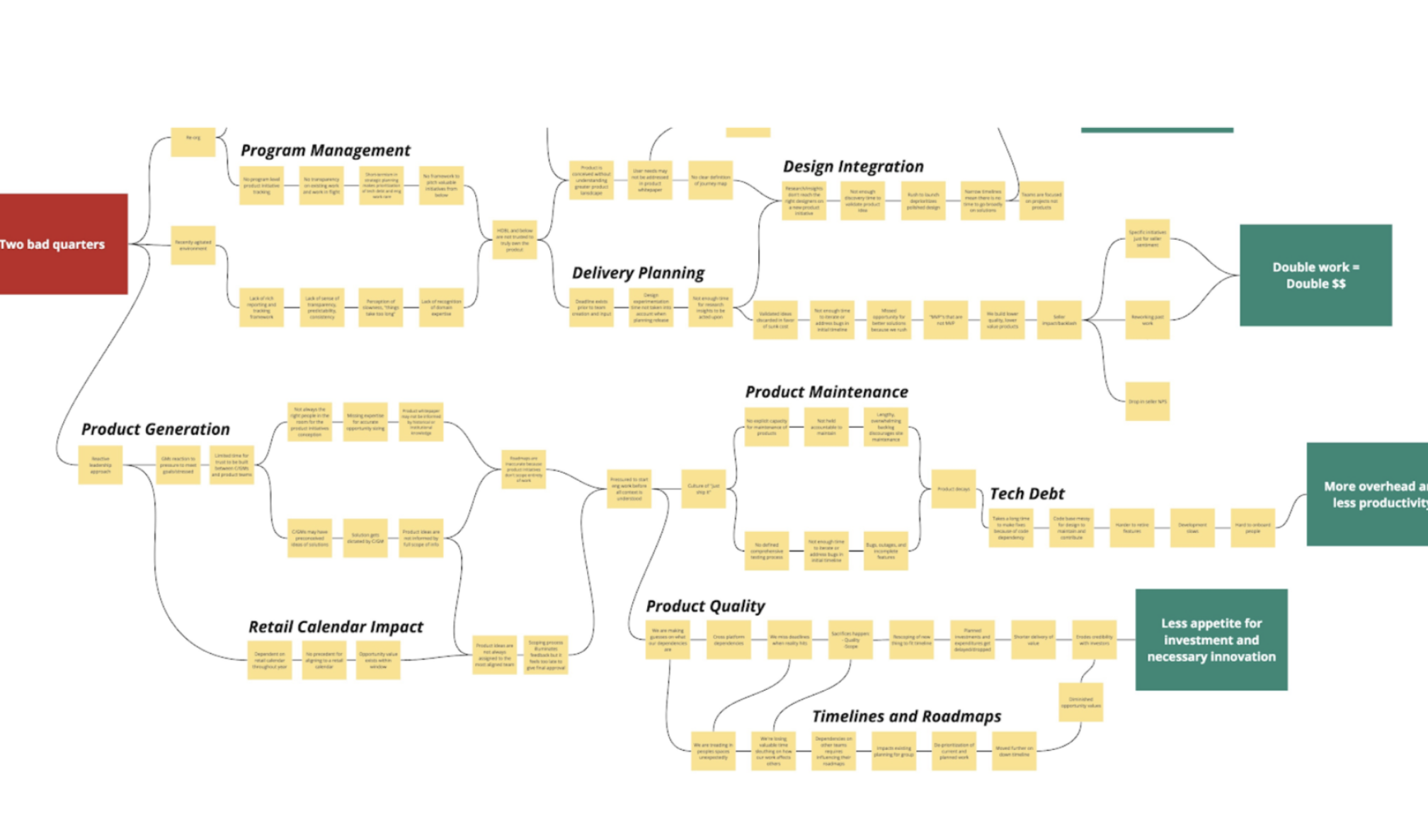
Problem synthesis: Key findings and friction points
Reflections
Consulting work is a strange thing. You arrive in an organization, spend months learning how it thinks and where it gets stuck, and then you leave — hoping what you built is durable enough to outlast your presence. This engagement stayed with me longer than most.
The "Etsy Way" wasn't something we handed over as a finished artifact. It emerged from the organization through the work itself. Our role was less about providing answers and more about creating conditions where Etsy's own people could surface the right questions. That distinction matters. A transformation that depends on outside expertise fades the moment the consultants pack up. One that gets embedded into how people think and work — into the rituals, the language, the way decisions get made — can actually stick.
What I'd revisit: we invested a lot of energy designing the process for product teams, but we could have brought leadership into the experimentation much earlier. Outcome-based roadmaps are a hard sell when the people approving them are still thinking in feature terms. Every time we got a VP into a user research session, the conversation shifted. I'd prioritize that proximity from day one next time.